
Road Signs Test Study Guide: A Comprehensive Plan
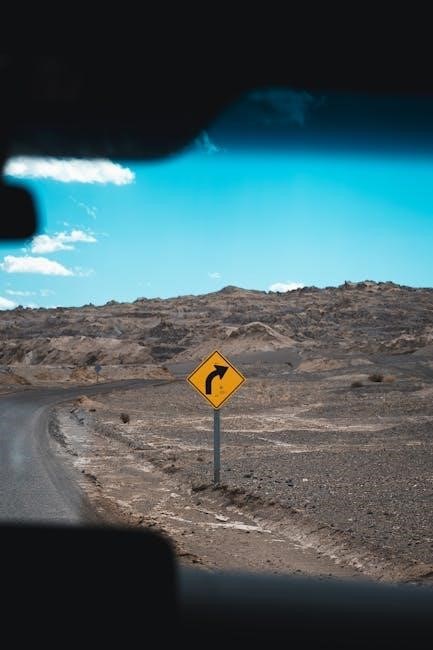
Preparing for your road signs test requires diligent study and practice. Utilize revision notes and mock tests, like the 81-question resource,
to confidently recognize crucial traffic signals and ensure safe driving practices.
The road signs test is a critical component of obtaining a driver’s license, evaluating your ability to interpret and respond appropriately to various traffic signals.
Successfully passing this test demonstrates a fundamental understanding of road safety and regulations, ensuring you can navigate roadways responsibly.
This comprehensive study guide is designed to equip you with the knowledge and skills necessary to excel on the exam. We will delve into the different categories of road signs,
exploring their meanings, shapes, and colors. Resources like the 81-question mock test available online provide valuable practice, reinforcing your learning and identifying areas needing improvement.
Remember, familiarity with road signs isn’t just about passing a test; it’s about protecting yourself and others on the road.
Consistent review and practical application are key to mastering this essential aspect of driving.
Updated on 03/31/2026 17:32:24
II. Understanding the Importance of Road Signs
Road signs are the language of the highway, communicating vital information to drivers and pedestrians alike. They aren’t merely suggestions; they are legally binding instructions designed to maintain order, prevent accidents, and ensure the safe flow of traffic.
Ignoring or misinterpreting a road sign can have severe consequences, ranging from minor traffic violations to serious collisions. Understanding their meaning allows for quick, informed decisions, reducing reaction time and minimizing risk.
Preparation for the road signs test, utilizing resources like online revision notes and practice tests (such as the 81-question assessment), isn’t just about passing an exam. It’s about cultivating a proactive safety mindset and becoming a responsible, attentive driver. Mastering these signals is paramount for everyone’s well-being.
III. Categories of Road Signs
Road signs are systematically categorized to facilitate quick recognition and understanding by drivers. These categories aren’t arbitrary; they’re based on the type of information conveyed. Familiarizing yourself with these groupings is a crucial step in preparing for your road signs test and becoming a safer driver.
The primary categories include Regulatory Signs (laws you must follow), Warning Signs (potential hazards ahead), Guide Signs (route information), Lane Control Signs (directing traffic flow), and Temporary Traffic Control Signs (related to construction or maintenance).
Effective study, incorporating resources like comprehensive revision notes and mock tests – such as the 81-question assessment – should focus on distinguishing between these categories and recognizing the specific meanings within each. This structured approach will significantly improve your test performance and on-road awareness.
A. Regulatory Signs
Regulatory signs inform drivers of laws and regulations they must obey. These signs are legally binding, and disregarding them can result in fines or, more seriously, accidents. Recognizing these signs is paramount for safe and lawful driving, and a significant portion of your road signs test will likely focus on them.
Common examples include Stop signs, Yield signs, Speed Limit signs, and signs prohibiting actions like No Parking or specific Turn Prohibitions. Understanding the precise meaning of each symbol and color is essential.
Thorough preparation involves studying detailed breakdowns of each regulatory sign and practicing identification through mock tests. Resources, like the 81-question assessment, can help solidify your understanding and boost your confidence for the exam.
B. Warning Signs
Warning signs alert drivers to potential hazards or changing road conditions ahead. Unlike regulatory signs, they don’t prohibit actions but advise caution. These signs are typically yellow and diamond-shaped, utilizing symbols to convey the nature of the danger.
Expect to encounter signs indicating Curves or Turns, Intersections, the presence of Pedestrians or School Zones, Railroad Crossings, and adverse Road Conditions. Recognizing these signs allows drivers to adjust their speed and driving behavior accordingly, preventing accidents.
Effective study involves memorizing the symbols and understanding the specific risks each sign represents. Utilizing practice tests, such as the 81-question resource, will reinforce your ability to quickly and accurately identify warning signs.
C. Guide Signs
Guide signs provide crucial information for navigation, assisting drivers in reaching their destinations. These signs come in various colors and shapes, each serving a distinct purpose. They don’t enforce laws or warn of immediate dangers, but rather offer directional and informational assistance.
Common types include Destination Signs indicating cities and towns, Route Markers identifying highways and interstates, and Service Signs pointing to essential amenities like gas stations, food, and lodging. You’ll also find Recreational and Cultural Interest Signs highlighting nearby attractions.
Mastering guide signs is vital for efficient and stress-free travel. Practice recognizing these signs, utilizing resources like comprehensive mock tests, to confidently navigate unfamiliar routes and reach your intended location.
D. Lane Control Signs
Lane control signs are essential for managing traffic flow and ensuring orderly movement on roadways. These signs dictate permissible movements within specific lanes, enhancing safety and reducing congestion. Understanding these signs is crucial for avoiding violations and maintaining a smooth traffic experience.
Lane Use Control Signs indicate which maneuvers are allowed in each lane – such as left turns only or straight through traffic. HOV Lane Signs designate lanes reserved for high-occupancy vehicles, promoting carpooling and reducing emissions.
Familiarize yourself with the various lane control markings and symbols. Practice identifying these signs through dedicated study materials and mock tests to confidently navigate complex intersections and highway configurations.
E. Temporary Traffic Control Signs
Temporary Traffic Control Signs are deployed during construction, maintenance, or emergency situations to guide drivers safely through altered road conditions. These signs are vital for protecting both workers and motorists, often indicating lane closures, detours, reduced speed limits, and the presence of flaggers.
Recognizing these signs is paramount as conditions can change rapidly in work zones. Pay close attention to posted speed reductions and be prepared to merge lanes or follow detour routes.
These signs typically feature fluorescent orange coloring to enhance visibility. Consistent study and practice with sample questions will help you quickly identify and respond appropriately to temporary traffic control measures, ensuring a safe passage through affected areas.
IV. Regulatory Signs: Detailed Breakdown
Regulatory signs inform drivers of laws and regulations they must obey. These signs are legally binding, and disregarding them can result in fines or penalties. Mastery of these signs is crucial for passing your road signs test and ensuring safe driving habits.
Common examples include Stop signs, Yield signs, Speed Limit signs, No Parking/Standing signs, and Turn Prohibition signs. Each sign conveys a specific instruction, demanding immediate compliance.
Understanding the shape and color of regulatory signs is key; for instance, octagonal signs universally indicate Stop. Thoroughly review each type, practicing identification and interpreting their meaning to confidently navigate roadways and avoid violations.
A. Stop Signs
Stop signs are arguably the most critical regulatory sign, demanding a complete halt before proceeding. Their distinctive octagonal shape and red color are universally recognized, signifying an absolute requirement to stop.
Drivers must come to a complete stop at a clearly marked stop line, before entering the crosswalk, or before the intersection. Proceed only when it is safe to do so, yielding the right-of-way to pedestrians and other vehicles.
Failing to obey a stop sign is a serious traffic violation, potentially leading to accidents and substantial fines. Accurate recognition and understanding of stop sign protocols are essential for both the road signs test and safe driving practices.
B. Yield Signs
Yield signs, denoted by a triangular shape and red-and-white coloring, indicate that a driver must prepare to yield the right-of-way. Unlike stop signs, a complete stop isn’t always required, but drivers must slow down and assess the traffic situation carefully.
You must yield to pedestrians and vehicles already in the intersection or approaching closely enough that stopping would be dangerous. Proceed only when it’s safe, without causing other drivers to alter their speed or direction.
Understanding yield signs is crucial for navigating intersections smoothly and preventing collisions. Proper interpretation and response to yield signs are key components of the road signs test and demonstrate responsible driving habits.
C. Speed Limit Signs
Speed limit signs are rectangular and display the maximum legal speed allowed on a particular stretch of road. These signs are vital for maintaining safe traffic flow and reducing the risk of accidents. They are typically posted as you enter a new speed zone.
Pay close attention to these signs, as exceeding the posted speed limit can result in fines and endanger yourself and others. Speed limits can vary depending on road conditions, weather, and traffic density.
Recognizing and adhering to speed limit signs is a fundamental aspect of the road signs test. Demonstrating an understanding of these signs showcases your commitment to responsible and lawful driving practices.
D. No Parking/Standing Signs
No Parking and No Standing signs regulate vehicle placement along roadways, ensuring clear passage for traffic and emergency vehicles. Understanding the difference is crucial for the road signs test. “No Parking” means you cannot leave your vehicle for any period, while “No Standing” prohibits even brief stops for loading or unloading passengers.
These signs often include time restrictions or days of the week when the regulation is in effect. Ignoring these signs can lead to costly tickets and potential towing of your vehicle.
Familiarize yourself with the specific symbols and wording used on these signs to avoid violations and demonstrate responsible parking behavior. Recognizing these signs is essential for safe and lawful driving.
E. Turn Prohibition Signs
Turn Prohibition signs clearly indicate restrictions on turning movements at intersections. These signs are vital for maintaining traffic flow and preventing collisions. Common examples include “No Left Turn” and “No Right Turn” signs, often accompanied by specific time restrictions or conditions.
Pay close attention to the placement of these signs, as they apply from the point where the sign is visible until a cancellation sign appears. Disregarding a turn prohibition can result in a traffic violation and potentially dangerous situations.
Successfully identifying these signs on the road signs test demonstrates your understanding of traffic laws and commitment to safe driving practices. Always observe and obey these restrictions to ensure a smooth and secure journey.
V. Warning Signs: Identifying Potential Hazards
Warning signs are crucial for alerting drivers to potential dangers ahead on the roadway. These signs utilize yellow diamonds and symbolic illustrations to convey upcoming hazards, allowing drivers to adjust their speed and driving behavior accordingly.
Recognizing these signs is paramount for safe driving, as they provide advance notice of conditions that may require extra caution. Common examples include warnings for curves, intersections, pedestrian crossings, railroad crossings, and changing road conditions.
Mastering warning sign identification on the road signs test demonstrates your ability to anticipate and react to potential hazards, contributing to a safer driving experience for yourself and others.
A. Curve/Turn Warning Signs
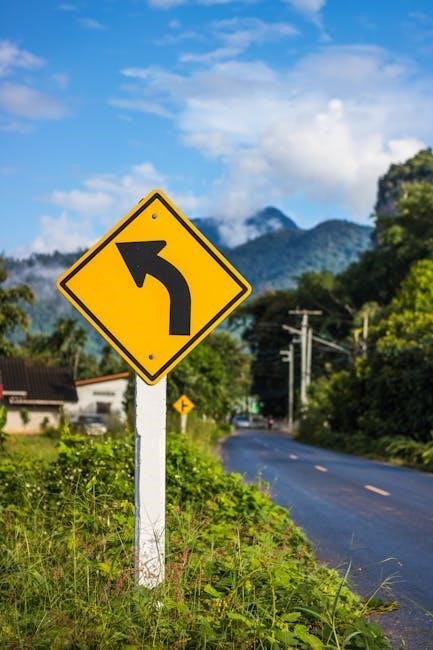
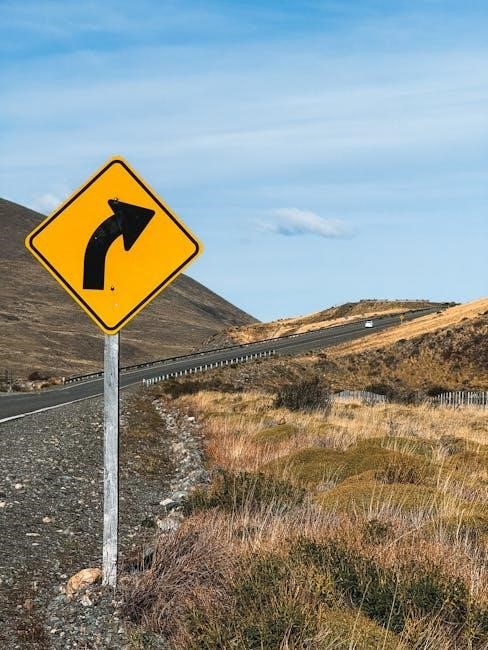
Curve and turn warning signs are vital for safe navigation, alerting drivers to upcoming changes in road direction. These signs typically feature a yellow diamond shape with an arrow curving left or right, indicating the nature of the bend ahead.
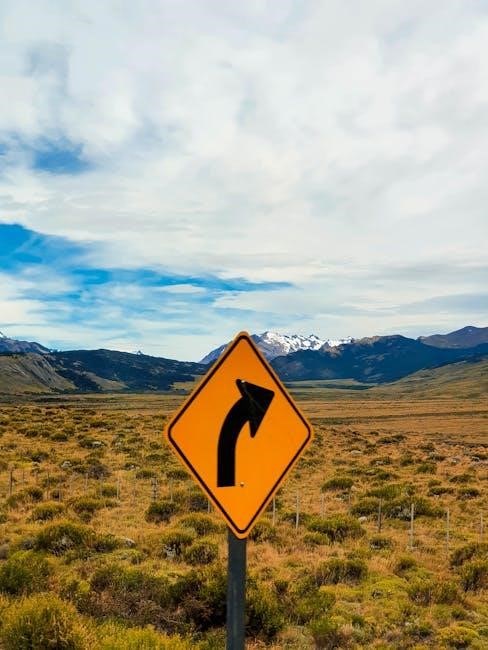
Understanding the specific arrow depiction is key; a sharper curve necessitates a more pronounced bend in the arrow. Drivers should reduce speed before entering a curve, maintaining control and avoiding sudden braking or steering maneuvers.
Familiarize yourself with variations, including signs indicating multiple curves or hairpin turns. Recognizing these signs on the road signs test demonstrates your awareness of potential hazards and commitment to responsible driving practices.
B. Intersection Warning Signs
Intersection warning signs prepare drivers for crossing roadways, signaling potential conflicts with other traffic. These signs commonly display a yellow diamond with intersecting lines, indicating an upcoming junction.
Variations exist to denote specific intersection types, such as cross roads, T-intersections, or Y-intersections. Recognizing these nuances is crucial for anticipating traffic patterns and yielding appropriately.
Pay close attention to signs indicating traffic signals or stop signs at the intersection. These warnings emphasize the need for increased vigilance and adherence to traffic control devices. Mastering intersection sign recognition is essential for passing the road signs test and ensuring safe driving habits.
C. Pedestrian/School Zone Warning Signs
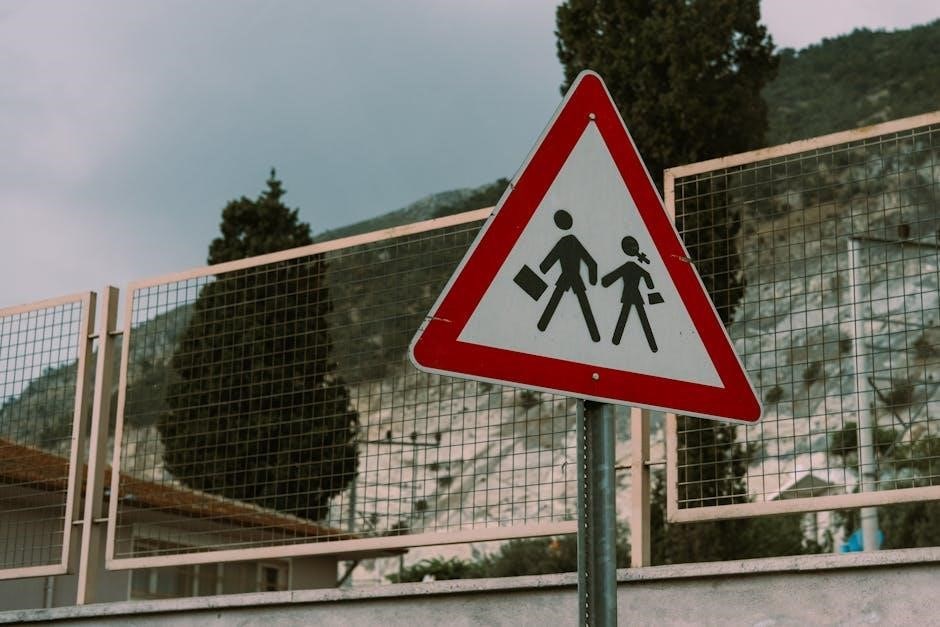
Pedestrian and school zone warning signs alert drivers to areas with increased vulnerability, demanding heightened awareness and reduced speeds. These signs often depict silhouettes of children walking or playing, signifying the presence of students or pedestrians.
School zone signs frequently include specific speed limits that are enforceable during designated hours, typically indicated on the sign itself. Drivers must strictly adhere to these reduced speed limits to ensure the safety of children.
Be particularly cautious during school drop-off and pick-up times, as pedestrian traffic is at its peak. Recognizing these signs and responding appropriately is vital for passing the road signs test and protecting vulnerable road users.
D. Railroad/Crossing Warning Signs
Railroad and crossing warning signs are crucial for preventing tragic accidents involving trains and vehicles. These signs typically feature a black “X” symbol superimposed on yellow circular backgrounds, indicating an upcoming railroad crossing.
Crossbuck signs, resembling a large “X,” are the most common and signify the presence of a railroad crossing. Drivers must slow down, look and listen for approaching trains before proceeding. Some crossings also feature flashing red lights and gates for added safety.
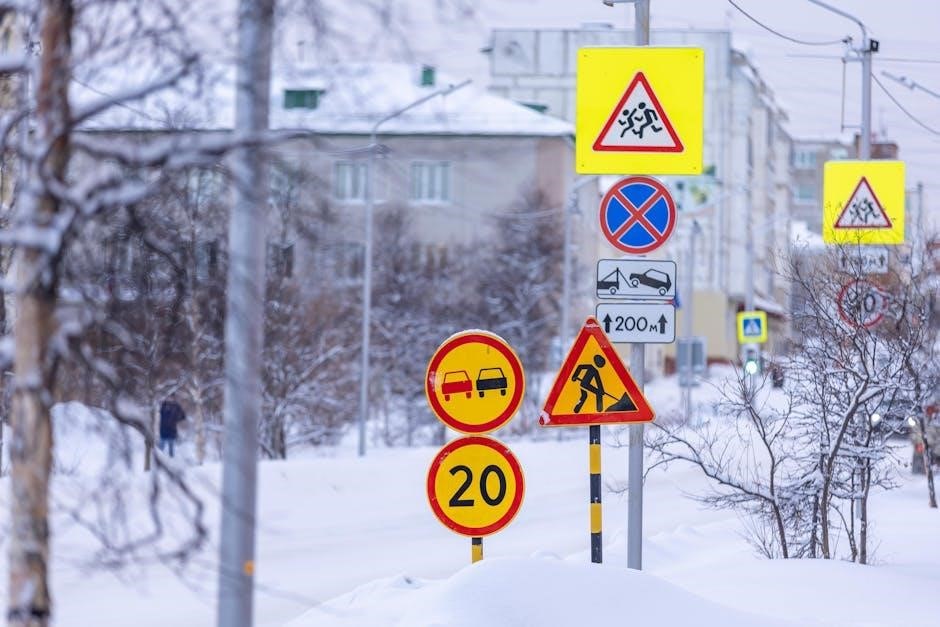
Always yield the right-of-way to trains, as they have the legal right-of-way at all crossings. Never attempt to cross the tracks if a train is approaching or the gates are down. Recognizing these signs is essential for both the test and safe driving.
E. Road Condition Warning Signs
Road condition warning signs alert drivers to potential hazards related to the road surface or environment. These signs are vital for adjusting driving behavior to maintain control and prevent accidents. Common examples include signs indicating slippery roads, bumps, or uneven pavement.
Signs depicting a car skidding warn of potentially icy or wet conditions, requiring reduced speed and increased following distance. Bump or dip signs prepare drivers for sudden changes in road elevation, preventing loss of control. Uneven pavement signs signal areas needing caution.
Pay close attention to these warnings and adjust your speed accordingly. Recognizing these signs is crucial for safe driving and successfully passing your road signs test. Prioritize safety and awareness when encountering these conditions.
VI. Guide Signs: Navigating Your Route
Guide signs assist drivers in navigating to destinations and identifying points of interest along their journey. These signs provide crucial information about routes, distances, and available services, ensuring efficient and stress-free travel. They are generally color-coded for easy recognition.
Destination signs display the names of cities, towns, and other locations, helping drivers confirm they are heading in the right direction. Route markers indicate highway and interstate numbers, allowing for seamless navigation across long distances. Service signs highlight the availability of gas, food, lodging, and other essential amenities.
Recreational and cultural interest signs point to parks, historical sites, and other attractions. Familiarize yourself with these signs to confidently navigate and enjoy your travels.
A. Destination Signs
Destination signs are pivotal for drivers seeking specific locations, clearly displaying the names of cities, towns, and prominent landmarks. These signs are crucial for confirming route direction and ensuring drivers remain on course towards their intended destination. They often feature the name of the location and the associated highway or road number.
Understanding destination sign variations is key; some signs indicate immediate exits, while others provide distances to upcoming destinations. Pay close attention to the font size and color, as these can offer additional clues. Recognizing these signs minimizes confusion and promotes safer navigation.
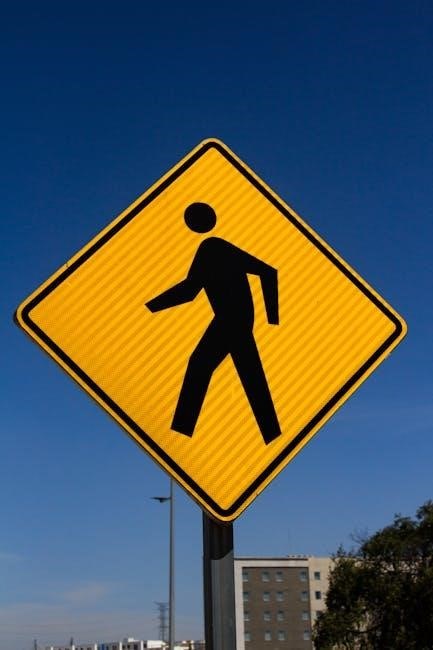
Effective use of destination signs contributes to a smoother, more efficient journey.
B. Route Markers
Route markers are essential for identifying and following numbered highways and interstates. These signs utilize a shield shape, displaying the route number prominently, allowing drivers to easily track their progress along a designated path. Familiarity with common route marker designs – like the familiar interstate shield – is vital for successful navigation.
Understanding route marker variations is crucial; different states may have slightly different designs. Pay attention to auxiliary route markers, which indicate spurs or alternate routes branching off the main highway. Recognizing these nuances prevents incorrect turns and ensures adherence to the planned route.
Mastering route markers streamlines travel and enhances road trip confidence.
C. Service Signs (Gas, Food, Lodging)
Service signs are invaluable for locating essential amenities during travel. These signs, typically blue in color, depict icons representing available services like gasoline stations, restaurants, and lodging facilities. Recognizing these symbols quickly allows drivers to plan stops efficiently and address immediate needs while on the road.
Pay close attention to the specific icons; a fork and knife indicate food, a gas pump signifies fuel, and a bed represents lodging. Understanding the range of services indicated – including hospitals, repair shops, and rest areas – enhances preparedness for unexpected situations.
Familiarity with service signs promotes safer and more comfortable journeys.
D. Recreational/Cultural Interest Signs
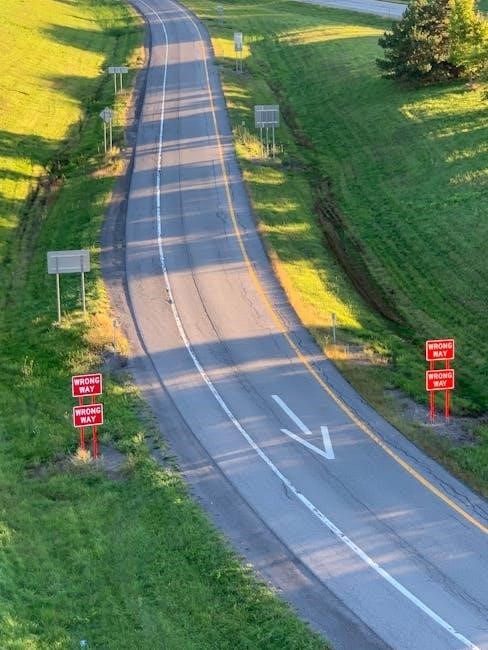
Recreational and cultural interest signs, often brown in color, guide travelers to points of interest. These signs highlight parks, historical sites, scenic overlooks, and other attractions designed to enhance the travel experience. Recognizing these symbols allows drivers to discover nearby destinations and enrich their journeys beyond simply reaching a final destination.
These signs utilize pictorial representations to quickly convey the type of attraction available. Expect to see icons for campgrounds, museums, zoos, and natural wonders. Understanding these symbols broadens awareness of local opportunities and encourages exploration.
Mastering these signs transforms a simple drive into a memorable adventure.
VII. Lane Control Signs: Managing Traffic Flow
Lane control signs are crucial for maintaining order and safety on roadways. These signs dictate permissible movements within specific lanes, preventing confusion and reducing the risk of collisions. They utilize arrows and symbols to clearly indicate which maneuvers are allowed – straight travel, turning, or merging.
Understanding lane use control signs is paramount for navigating complex intersections and highway systems. Pay close attention to signs indicating lane assignments for different destinations or HOV (High Occupancy Vehicle) lanes. Recognizing these signs ensures drivers are in the correct lane well in advance.
Proper lane discipline contributes significantly to smoother traffic flow and overall road safety.
A. Lane Use Control Signs
Lane use control signs are designed to guide drivers into the correct lanes for their intended destination. These signs often feature large arrows indicating permitted movements, such as left turns only, right turns only, or straight travel. Recognizing these signs well in advance is vital for safe and efficient navigation.
Pay attention to signs displaying multiple arrows, as they may indicate several acceptable options within a lane. Conversely, a single arrow signifies a restricted maneuver. Misinterpreting these signs can lead to last-minute lane changes and potential hazards.
Mastering lane use control signs is a key component of passing your road signs test and becoming a confident, responsible driver.
B. HOV Lane Signs
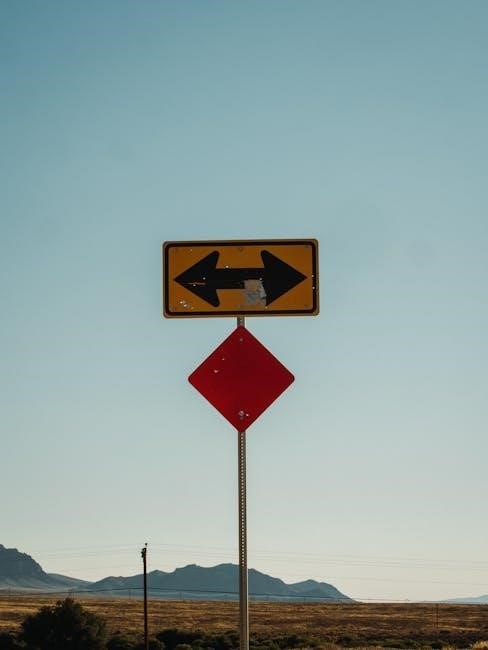
High Occupancy Vehicle (HOV) lane signs identify roadways reserved for vehicles with a specified number of occupants. These lanes aim to reduce congestion and promote carpooling, contributing to a more sustainable transportation system. Typically, HOV lanes require at least two or three passengers, including the driver.
HOV lane signs often display a diamond symbol with an indication of the minimum occupancy requirement. It’s crucial to understand the specific rules for HOV lanes in your area, as requirements can vary. Violating HOV lane restrictions can result in fines.
Familiarize yourself with these signs to determine eligibility and avoid penalties. Recognizing HOV lane signs is essential for responsible driving and efficient commuting.
VIII. Temporary Traffic Control Signs: Construction & Maintenance
Temporary traffic control signs are vital for navigating construction zones and maintenance areas safely. These signs alert drivers to changing road conditions, reduced speed limits, lane closures, and the presence of workers. They are typically orange in color to maximize visibility and indicate a non-permanent hazard.
Common temporary signs include those indicating “Road Work Ahead,” “Lane Closed,” and specific speed reductions. Pay close attention to flaggers and follow their instructions diligently. Understanding these signs is crucial for protecting both drivers and road crews.
Always reduce speed and exercise extra caution when encountering temporary traffic control signs. Ignoring these warnings can lead to accidents and delays.
IX. Common Mistakes to Avoid on the Road Signs Test
Many candidates stumble on the road signs test due to preventable errors. A frequent mistake is misinterpreting warning signs, confusing their meaning with regulatory signs. Failing to recognize less common signs, or hesitating due to uncertainty, also leads to point deductions.
Another common error is rushing through the test without carefully reading each question and analyzing the sign presented. Don’t assume you know the answer; always confirm with your knowledge base. Overlooking small details within the sign’s imagery can also be detrimental.
Thorough preparation, including practice tests, is key to avoiding these pitfalls and achieving a passing score.
X. Practice Tests and Resources
Success on the road signs test hinges on consistent practice. Numerous online resources offer mock tests, mirroring the actual exam format. Utilize the 81-question test mentioned previously as a starting point to gauge your current knowledge and identify areas needing improvement.
State Department of Motor Vehicles (DMV) websites are invaluable, often providing official practice tests and detailed sign guides. Consider using mobile apps designed for road sign recognition, allowing for convenient study on the go. Reviewing a comprehensive study guide alongside practice tests is highly recommended.
Don’t limit yourself to one resource; diversify your preparation for a well-rounded understanding.
XI. Advanced Road Sign Recognition (Less Common Signs)
Beyond the frequently encountered signs, mastering less common signals is crucial for comprehensive road awareness. These include signs related to specific hazards, such as low clearance warnings, slippery when wet indicators, and flagger signals.
Pay close attention to regulatory signs governing specific vehicle types or maneuvers, like weight limit restrictions or bicycle route markers. Familiarize yourself with dynamic message signs, which provide real-time information about traffic conditions and potential delays.
Thorough preparation, utilizing diverse resources, will equip you to confidently interpret these advanced signs, enhancing your safety and test performance.