Easy piano songs with letters offer a simplified approach for beginners, replacing complex sheet music with note letters. Free PDF resources make learning accessible and fun!
What are Letter Notes for Piano?
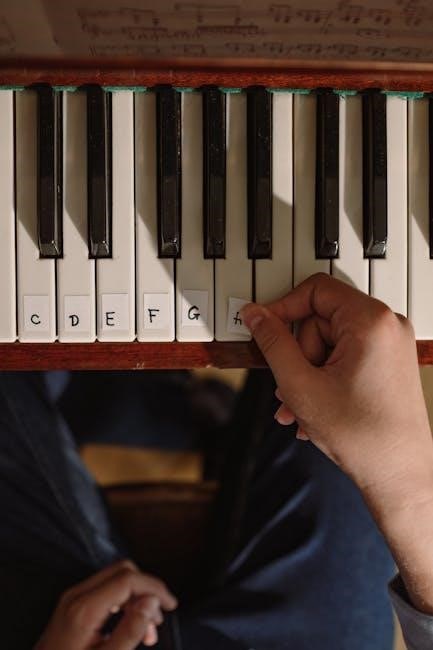
Letter notes for piano represent each key on the keyboard with a corresponding letter – C, D, E, F, G, A, and B. This system bypasses the need to decipher traditional musical notation, making piano learning significantly more approachable for beginners. Instead of reading lines and spaces on a staff, you simply identify the letter associated with each key you need to play.
These letter notations are particularly useful when exploring easy piano songs, often available as PDF downloads. Many resources, like Pianochord.org, specifically cater to beginners by providing songs arranged with letter notes. This method allows aspiring pianists to focus on finger placement and rhythm without the added complexity of standard music theory. It’s a fantastic stepping stone towards understanding more complex notation later on, fostering a love for music and building confidence from the very start.
Essentially, letter notes democratize piano playing, making it accessible to anyone eager to learn, regardless of their musical background.
Benefits of Using Letter Notes for Beginners
Utilizing letter notes offers numerous advantages for those embarking on their piano journey. Firstly, it drastically reduces the initial learning curve, eliminating the intimidation factor of traditional sheet music. Beginners can immediately start playing recognizable melodies, like “Mary Had a Little Lamb” or “Happy Birthday,” found readily in easy piano songs PDF formats.
This simplified approach fosters quicker progress and builds confidence. Focusing on letter recognition allows learners to concentrate on developing finger dexterity, rhythm, and coordination. Furthermore, letter notes encourage a more intuitive understanding of musical relationships, paving the way for future exploration of music theory.
The availability of free PDF resources online, such as those found on Pianochord.org, makes learning affordable and accessible. It’s a fun, straightforward method that ignites a passion for the instrument, potentially inspiring further musical study and even a transition to reading standard notation.
Popular Easy Piano Songs with Letters (PDF)
Discover a wealth of easy piano songs in PDF format, perfect for beginners! Classics like “Chopsticks,” “Ode to Joy,” and “Mary Had a Little Lamb” await.
“Mary Had a Little Lamb” ─ A Classic Beginner Song
Mary Had a Little Lamb stands as a cornerstone for aspiring pianists, offering a gentle introduction to musical concepts. Its simple melody and repetitive structure make it incredibly accessible, especially when presented with letter notes. This classic tune is frequently included in beginner piano songbooks and readily available as a free PDF download from various online resources like Pianochord.org.
Learning this song with letters eliminates the initial hurdle of deciphering traditional sheet music, allowing students to focus on finger placement and rhythm. The song primarily utilizes a limited range of notes, often staying within the white keys, further simplifying the learning process. Many online tutorials demonstrate how to play “Mary Had a Little Lamb” step-by-step, using letter notation.
The availability of PDF versions means students can easily print and practice the song at their own pace. It’s a fantastic confidence booster and a delightful way to begin a musical journey, fostering a love for the piano from the very first notes!
“When the Saints Go Marching In” ─ Simple and Joyful
“When the Saints Go Marching In” is a universally recognized and uplifting tune, making it an excellent choice for beginner piano players. Its cheerful melody and straightforward chord progression translate beautifully into letter note arrangements, readily found as free PDF downloads online. This song’s repetitive nature aids memorization and builds confidence in new musicians.
Utilizing letter notes allows beginners to bypass the complexities of standard musical notation, focusing instead on developing hand coordination and rhythm. The song’s relatively slow tempo provides ample time to practice each note accurately. Resources like Pianochord.org often feature simplified versions specifically designed for learners.
The joyful spirit of the song makes practice more enjoyable, encouraging continued engagement with the instrument. Finding a PDF version with clearly marked letter notes is key to a successful learning experience, paving the way for more complex pieces and a lasting appreciation for music!
“Happy Birthday” ─ A Must-Know Tune
“Happy Birthday” is arguably the most universally recognized song, making it a fantastic starting point for beginner piano students. Its simplicity and cultural significance provide instant gratification and motivation. Numerous free PDF resources online offer letter note arrangements, specifically tailored for those new to the instrument.
Learning “Happy Birthday” with letter notes eliminates the initial hurdle of deciphering traditional sheet music. This allows beginners to concentrate on finger placement, rhythm, and coordination. The song’s repetitive melodic phrases reinforce learning and build muscle memory. Websites dedicated to easy piano music, like Pianochord.org, frequently provide beginner-friendly versions.
Being able to play “Happy Birthday” is a practical skill, offering a way to participate in celebrations and share the joy of music. A well-formatted PDF with clear letter notation will ensure a smooth and rewarding learning process, fostering a love for playing the piano.
“Ode to Joy” ⎻ Beethoven for Beginners
Believe it or not, even a masterpiece like Beethoven’s “Ode to Joy” can be accessible to piano beginners! Simplified arrangements utilizing letter notes break down this iconic melody into manageable segments. Finding a suitable PDF version is key to a successful learning experience, focusing on the most recognizable theme.
These arrangements typically focus on playing with the right hand, utilizing only a few notes, and often sticking to the white keys initially. This approach allows beginners to grasp the melody without being overwhelmed by complex chords or rhythms. Websites offering easy piano songs with letters frequently include “Ode to Joy” in their repertoire.
Successfully playing a portion of a classical piece like this can be incredibly rewarding, boosting confidence and inspiring further musical exploration. A clear, well-formatted PDF will guide beginners through the notes, making Beethoven’s genius attainable.
“Chopsticks” ─ A Traditional First Song
“Chopsticks” holds a special place as a quintessential first piano song for countless learners. Its simple, repetitive melody makes it incredibly easy to pick up, even for those with no prior musical experience. Numerous PDF resources online specifically cater to beginners learning “Chopsticks” with letter notes.
The beauty of this tune lies in its limited range and straightforward rhythm. Letter notes clearly indicate which keys to press, eliminating the need to decipher traditional sheet music. Many arrangements focus on playing with one hand initially, building coordination before introducing both;
Finding a free PDF version with large, clear letter notation is highly recommended. “Chopsticks” isn’t just about learning notes; it’s about building confidence and experiencing the joy of making music. It’s a stepping stone to more complex pieces, and a fun tradition for piano students!
Finding Free PDF Resources
Numerous websites offer free PDFs of easy piano songs with letters. Pianochord.org is a great starting point, alongside simple web searches for beginner tunes.

Pianochord.org and Similar Websites

Pianochord.org stands out as a valuable resource for musicians seeking easy piano songs presented with letter notation. The site provides a curated collection, specifically designed for beginners, eliminating the initial hurdle of deciphering traditional sheet music. Their mini edition ebook, available for download, includes classics like “Mary Had a Little Lamb,” “When the Saints Go Marching In,” and “Brother John,” all conveniently formatted with letter notes.
Beyond Pianochord.org, several other websites cater to this learning style. Many offer similar arrangements of popular tunes, often in easily downloadable PDF format. The key benefit of these platforms is their accessibility – they empower individuals with no prior musical training to begin playing recognizable melodies almost immediately.
Furthermore, Pianochord.org’s recent feature allowing key shifting is incredibly useful, adapting songs to different instrument ranges or skill levels. This adaptability, coupled with the option to switch between letter notes and solfege (Do Re Mi), enhances the learning experience and caters to diverse preferences. These resources truly democratize music learning, fostering a love for the instrument and potentially inspiring further musical exploration.
Searching for “Easy Piano Songs with Letters PDF”
A straightforward internet search using the keywords “easy piano songs with letters PDF” yields a wealth of results, catering to aspiring pianists. This search phrase quickly directs you to numerous websites offering free sheet music arrangements tailored for beginners. Expect to find popular choices like “Happy Birthday” and “Chopsticks” readily available in downloadable PDF format, utilizing letter notation instead of traditional musical notation.
Beyond dedicated music websites, platforms like online music communities and educational resource hubs also host collections of these simplified arrangements. Be mindful of website credibility when downloading PDFs; prioritize sources known for accuracy and legality.
Refining your search with specific song titles (e;g., “Ode to Joy letter notes PDF”) can further narrow down results. Remember that many sites, like Pianochord.org, offer not only PDFs but also interactive features, allowing you to customize the key or notation style. Effective searching unlocks a vast library of accessible piano music for immediate enjoyment and learning.

Understanding Basic Piano Keys and Notation
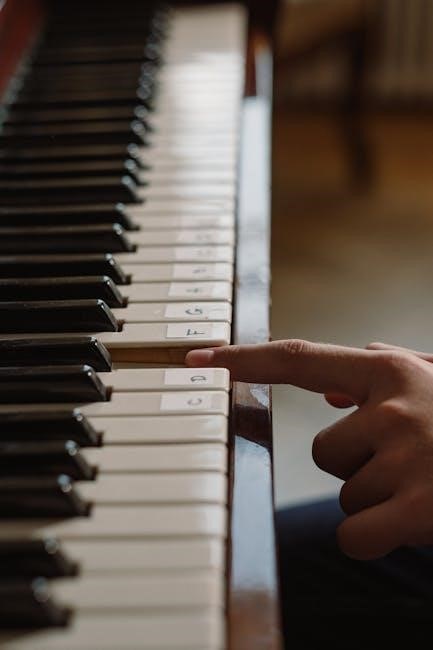
Letter notes correspond to white keys (C, D, E, F, G, A, B), forming simple melodies. Mastering these basics unlocks easy piano songs for beginners!
White Key Notes (C, D, E, F, G, A, B)
Understanding the white keys is foundational for any beginner piano player utilizing letter notes. These keys represent the natural notes – C, D, E, F, G, A, and B – and form the basis of countless melodies. When learning easy piano songs with letters, you’ll primarily focus on these notes initially.
The arrangement is sequential; moving from left to right on the piano corresponds to moving alphabetically through the notes. C is always to the left of D, D to the left of E, and so on. This pattern is crucial for recognizing intervals and understanding musical relationships. Many simple tunes, especially those designed for beginners, are constructed entirely using these white key notes.
Resources like PDFs of easy piano songs with letters often highlight these notes, making it easier to identify them on the keyboard. Focusing on mastering the white keys before introducing sharps and flats simplifies the learning process and builds a solid foundation for future musical exploration. It’s the perfect starting point for anyone eager to learn piano!
Beginning with melodies exclusively on the white keys is a fantastic approach when using easy piano songs with letters. This method simplifies music theory for beginners, eliminating the complexity of sharps and flats initially. Many classic, recognizable tunes can be played using just these natural notes, providing immediate gratification and building confidence.
PDF resources offering letter notation for piano frequently start with these simple melodies. Songs like “Mary Had a Little Lamb” and “Ode to Joy” (simplified versions) are excellent examples. These tunes reinforce note recognition and hand positioning without overwhelming the learner.
The focus remains on translating the letter notes (C, D, E, F, G, A, B) directly to the corresponding keys on the piano. This builds muscle memory and a fundamental understanding of musical intervals. As proficiency grows, learners can gradually introduce black keys, expanding their repertoire and musical capabilities. It’s a gentle, effective pathway to piano playing!

Tips for Beginner Piano Players
Start slowly with one hand, then combine. Consistent, regular practice—even short sessions—is key to improvement when learning easy piano songs with letters PDFs.
Starting with One Hand at a Time
When embarking on your piano journey with easy piano songs and letter notes PDFs, a crucial first step is to master each hand independently. Resist the urge to immediately combine both hands; it can lead to frustration and hinder progress. Begin by focusing solely on the right hand, carefully playing through the melody using the letter notes as your guide.
Take your time, ensuring accuracy and a comfortable tempo. Once you’re confident with the right hand, switch your attention to the left hand. Often, beginner arrangements feature simple chords or a basic accompaniment pattern. Practice this separately until it feels natural and fluid.
This isolated practice builds muscle memory and allows you to internalize the individual parts before attempting to coordinate them. Don’t rush this stage! It’s the foundation for playing more complex pieces later on. Remember, patience and focused practice are your allies in learning easy piano songs.
Practicing Regularly for Improvement
Consistent practice is paramount when learning easy piano songs with letter notes PDFs. Short, frequent sessions are far more effective than infrequent, lengthy ones. Aim for at least 15-30 minutes of practice each day, even if it’s just reviewing a single song. Regularity builds muscle memory and reinforces what you’ve learned.
Utilize the PDF resources to gradually expand your repertoire. Don’t be afraid to revisit songs you’ve already mastered; this reinforces technique and builds confidence. Focus on accuracy and rhythm, rather than speed. A slow, precise performance is always preferable to a rushed, error-filled one.
Consider setting small, achievable goals for each practice session. Celebrate your progress, no matter how small! Remember, learning piano is a journey, and consistent effort, combined with readily available letter note PDFs, will unlock your musical potential.