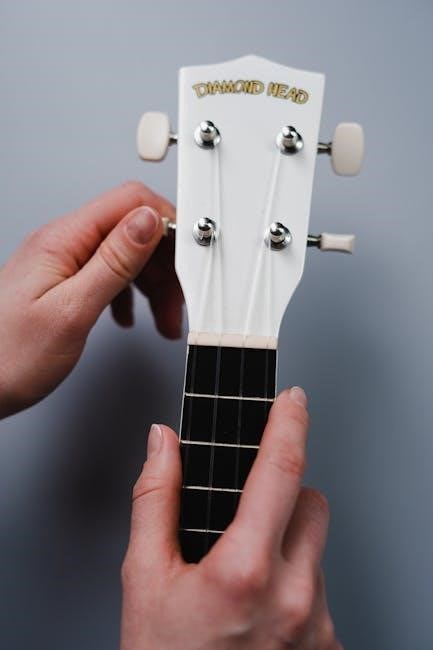
Ukulele Chord Chart with Finger Numbers PDF: A Comprehensive Guide

Unlock your musical potential with a readily available PDF guide! These charts simplify learning‚ offering clear finger placements for major‚ minor‚ and seventh chords.
Download and print resources from Acoustic Music TV‚ Gliss Prints‚ and The Good Footprint to enhance your ukulele journey today!
Ukulele chord charts are essential tools for both beginners and experienced players‚ providing a visual representation of finger placements on the fretboard. These charts are particularly valuable when learning new chords or referencing them during practice or performance. The availability of PDF versions adds convenience‚ allowing for easy printing and portability.
A ukulele chord chart with finger numbers takes this a step further‚ explicitly indicating which finger to use for each note. This is incredibly helpful for those new to the instrument‚ as it eliminates guesswork and promotes proper technique from the start. Charts often cover major‚ minor‚ and seventh chords‚ forming the foundation of countless songs.
Resources like Acoustic Music TV and Gliss Prints offer comprehensive charts‚ while The Good Footprint provides a free PDF guide. These resources cater to soprano‚ concert‚ and tenor ukuleles‚ ensuring compatibility for most players. Utilizing these charts streamlines the learning process and unlocks a world of musical possibilities.
Why Use a Chord Chart with Finger Numbers?
Chord charts with finger numbers dramatically accelerate the learning curve for ukulele players. Instead of memorizing abstract diagrams‚ you receive direct instruction on which finger to place on which fret. This clarity is invaluable‚ especially for beginners struggling with coordination and muscle memory.
These charts minimize frustration by removing ambiguity. Knowing the correct finger placement prevents incorrect habits and ensures cleaner‚ more resonant chords. PDF format allows for convenient access – print a copy for practice‚ or view it on a tablet during lessons.

Resources like those from Acoustic Music TV‚ Gliss Prints‚ and The Good Footprint demonstrate the power of this approach. They offer charts covering major‚ minor‚ seventh‚ and even more complex chords. Ultimately‚ using finger-numbered charts fosters faster progress and a more enjoyable ukulele experience.
Understanding Ukulele Chord Diagrams
Ukulele chord diagrams are visual representations of the fretboard‚ simplifying chord shapes. Typically‚ vertical lines represent strings‚ and horizontal lines indicate frets. Dots on the diagram signify where to place your fingers‚ with numbers within the dots denoting which finger to use – 1 for index‚ 2 for middle‚ 3 for ring‚ and 4 for pinky.
PDF charts‚ like those offered by Gliss Prints and The Good Footprint‚ often include these numbered diagrams. Understanding that the diagram is viewed as if you’re holding the ukulele allows for accurate interpretation. A ‘0’ above a string means to play it open (without pressing any frets).
Resources from Acoustic Music TV also utilize this standard notation. Mastering this visual language unlocks a vast library of chords‚ enabling you to quickly learn and play countless songs. Consistent use of these diagrams builds fretboard familiarity and musical fluency.

Essential Major Chords
Master foundational chords like C‚ G‚ D‚ A‚ E‚ and F major! PDF charts from various sources simplify finger placement for quick learning.
C Major Chord – Finger Placement
Learning the C Major chord is a cornerstone for any ukulele beginner‚ and a clear PDF chart is invaluable. Typically‚ you’ll use three fingers for this chord. Place your ring finger (3rd finger) on the third fret of the A string. Simultaneously‚ position your index finger (1st finger) on the second fret of the G string.
Finally‚ your middle finger (2nd finger) goes on the second fret of the C string. Ensure your fingers are pressing down firmly just behind the frets to achieve a clean sound. Many PDF charts visually demonstrate this‚ using numbered fingers to indicate placement.
Remember to strum all four strings – G‚ C‚ E‚ and A – to hear the full C Major chord. Practice transitioning to and from the C Major chord to build muscle memory and improve your playing speed. Consistent practice with a PDF guide will solidify your understanding!
G Major Chord – Finger Placement
Mastering the G Major chord opens up a vast repertoire of songs on the ukulele. A helpful PDF chart will illustrate the finger positions clearly. Begin by placing your middle finger (2nd finger) on the second fret of the C string. Next‚ position your index finger (1st finger) on the second fret of the A string.
Your ring finger (3rd finger) then goes on the third fret of the E string. As with all chords‚ ensure your fingertips are pressing down firmly behind the frets for a clean‚ resonant sound. PDF resources often use numbered finger diagrams for easy comprehension.
Strum all four strings – G‚ C‚ E‚ and A – to hear the complete G Major chord. Practice switching between G Major and other chords like C Major to develop fluidity. Utilizing a PDF chord chart during practice will accelerate your learning process!
D Major Chord – Finger Placement
Learning the D Major chord is crucial for any ukulele player‚ and a PDF chart simplifies the process. Begin by placing your index finger (1st finger) on the second fret of the G string. Follow this by positioning your middle finger (2nd finger) on the third fret of the C string.
Finally‚ place your ring finger (3rd finger) on the second fret of the A string. Ensure each fingertip presses down firmly just behind the fret for a clear tone. PDF guides often visually represent these finger placements with numbered diagrams‚ making it easier to follow.
Strum all four strings – A‚ D‚ G‚ and C – to produce the D Major chord. Practice transitioning between D Major and other common chords to build muscle memory. A readily available PDF chord chart will be an invaluable tool during your practice sessions!
A Major Chord – Finger Placement
Mastering the A Major chord opens up a world of possibilities on the ukulele. A clear PDF chord chart will visually guide you through the finger placements. Begin by placing your index finger (finger 1) on the second fret of the G string. Next‚ position your middle finger (finger 2) on the second fret of the E string.
Finally‚ place your ring finger (finger 3) on the second fret of the C string. Ensure your fingertips are pressing down firmly behind the frets to achieve a clean sound. PDF resources often highlight these positions with numbered diagrams for easy understanding.
Strum all four strings – A‚ D‚ G‚ and E – to hear the A Major chord. Consistent practice‚ aided by a PDF chart‚ will solidify your technique and allow for smooth chord transitions. Enjoy exploring songs utilizing this fundamental chord!
E Major Chord – Finger Placement
Learning the E Major chord is crucial for any ukulele player. A well-designed PDF chord chart simplifies the process‚ providing a visual guide to finger positioning. Begin by placing your index finger (finger 1) on the first fret of the C string. Subsequently‚ position your middle finger (finger 2) on the second fret of the A string.
Then‚ place your ring finger (finger 3) on the second fret of the G string. Ensure each fingertip presses firmly just behind the fret for a clear tone. PDF charts often use numbered diagrams to illustrate these placements effectively.

Strum all four strings – A‚ D‚ G‚ and E – to produce the E Major chord. Regular practice‚ utilizing a PDF resource‚ will build muscle memory and facilitate seamless chord changes. Embrace the versatility of this essential chord!
F Major Chord – Finger Placement
Mastering the F Major chord can initially present a challenge‚ but a clear PDF ukulele chord chart makes it achievable. Begin by positioning your index finger (finger 1) on the first fret of the E string. Next‚ place your middle finger (finger 2) on the second fret of the G string.
Then‚ carefully position your ring finger (finger 3) on the second fret of the C string. A PDF chart will visually demonstrate these finger placements‚ often using numbered diagrams for clarity. Ensure your fingertips are pressing down firmly behind each fret to avoid buzzing.
Strum all four strings – A‚ D‚ G‚ and E – to hear the full F Major chord. Consistent practice with a PDF guide will build dexterity and allow for smooth transitions between chords. Don’t be discouraged; persistence is key!

Common Minor Chords
Explore soulful sounds with essential minor chords! PDF charts detail finger positions for A‚ C‚ D‚ and E minor‚ simplifying learning and expanding your repertoire.
A Minor Chord – Finger Placement
Mastering the A minor chord opens doors to countless songs! A typical A minor fingering‚ as shown in many ukulele chord chart PDFs‚ involves placing your middle finger on the second fret of the G string. Simultaneously‚ position your index finger on the first fret of the E string.
Leave the A string open for a clear‚ resonant tone. Some charts may offer alternative fingerings‚ but this is a common and beginner-friendly approach. Gliss Prints and Acoustic Music TV often include diagrams illustrating this placement.
Remember to apply gentle‚ even pressure to avoid buzzing. Practice transitioning smoothly between A minor and other chords to build dexterity. Utilizing a PDF allows for easy reference during practice sessions‚ ensuring correct finger placement and a beautiful‚ full sound. Consistent practice will solidify this essential chord in your skillset!
D Minor Chord – Finger Placement
Learning the D minor chord is crucial for playing melancholic and expressive tunes! A standard D minor fingering‚ frequently depicted in ukulele chord chart PDFs‚ requires your index finger to press down on the second fret of the G string. Next‚ place your middle finger on the third fret of the C string.
Ensure the A and E strings remain open for optimal sound. Resources like those from Gliss Prints and Acoustic Music TV visually demonstrate this configuration. Focus on clean finger placement to avoid unwanted buzzing.
A PDF chart provides a convenient‚ portable reference during practice. Experiment with different strumming patterns to explore the chord’s versatility. Consistent practice will build muscle memory‚ allowing for seamless transitions between D minor and other chords. Mastering this chord expands your musical palette significantly!
E Minor Chord – Finger Placement
Mastering the E minor chord unlocks a wealth of emotional depth in your ukulele playing! Commonly found in ukulele chord chart PDFs‚ the E minor is relatively straightforward. Position your index finger on the second fret of the A string. Then‚ place your middle finger on the second fret of the E string.
Leave the G and C strings open for a full‚ resonant sound. Gliss Prints and Acoustic Music TV offer visual aids to confirm correct finger placement. Prioritize pressing down firmly behind the frets to achieve clarity.
A PDF chart keeps this fingering readily accessible during practice sessions. Explore different strumming rhythms to discover the chord’s expressive potential. Regular practice builds dexterity and allows for smooth chord changes. This chord is a staple for countless songs!
C Minor Chord – Finger Placement
Unlock a melancholic tone with the C minor chord‚ a frequent inclusion in ukulele chord chart PDFs. To form this chord‚ place your ring finger on the third fret of the A string. Simultaneously‚ position your middle finger on the second fret of the G string.
Ensure your index finger gently rests on the first fret of the E string. Leave the C string open to complete the chord. Resources like Gliss Prints provide clear diagrams for visual learners.
A PDF chart offers a convenient reference during practice. Focus on clean finger placement to avoid buzzing. Experiment with different strumming patterns to explore the chord’s versatility. Mastering C minor expands your repertoire and allows you to play a wider range of songs with emotional depth!

Seventh Chords for Added Flavor
Elevate your playing with seventh chords! Ukulele chord chart PDFs often include G7‚ C7‚ and D7‚ adding a jazzy‚ complex harmony to your musical arrangements.
G7 Chord – Finger Placement
Mastering the G7 chord opens up a world of bluesy and jazzy possibilities on your ukulele. A typical G7 chord diagram‚ found within comprehensive ukulele chord chart PDFs‚ will illustrate a relatively straightforward finger placement. Generally‚ you’ll place your index finger on the first fret of the A string.
Next‚ your middle finger goes on the second fret of the E string. The ring finger then secures the second fret of the C string. Crucially‚ leave the G string open – no fingers are needed there! This configuration creates the distinctive G7 sound.
Referencing a PDF with finger numbers is incredibly helpful for beginners. These charts visually demonstrate which finger corresponds to each fret and string. Acoustic Music TV and Gliss Prints are excellent resources for finding these diagrams. Practice transitioning to and from the G7 chord to build muscle memory and fluidity in your playing. Remember consistent practice is key!
C7 Chord – Finger Placement
Learning the C7 chord adds a soulful dimension to your ukulele playing. Ukulele chord chart PDFs commonly depict this chord as requiring a slightly different approach than basic major chords. Typically‚ you’ll position your ring finger on the third fret of the A string.
Simultaneously‚ place your index finger on the first fret of the E string. Your middle finger then goes on the second fret of the C string; The G string remains open‚ contributing to the chord’s characteristic sound. Visual aids‚ like those found in resources from Gliss Prints‚ are invaluable for understanding these placements.
Utilizing a PDF with numbered fingerings simplifies the learning process‚ especially for beginners. Consistent practice‚ referencing diagrams from sources like Acoustic Music TV‚ will build dexterity and allow for smooth chord changes. Don’t hesitate to revisit the chart as needed!
D7 Chord – Finger Placement
Mastering the D7 chord opens up a world of bluesy and jazzy possibilities on your ukulele. Ukulele chord chart PDFs illustrate this chord as requiring a specific finger arrangement for optimal sound. Generally‚ you’ll place your index finger on the second fret of the G string.
Next‚ position your middle finger on the second fret of the E string. Your ring finger then goes on the third fret of the C string. The A string remains open‚ providing a crucial element of the chord’s tonality. Resources like those offered by Gliss Prints often present this visually.
Referencing a PDF with clear finger numbers is incredibly helpful‚ particularly when starting out. Consistent practice‚ alongside diagrams from Acoustic Music TV‚ will solidify your technique. Remember to focus on clean finger placement for a clear‚ resonant D7 chord!

Advanced Chord Types

Explore beyond basics with PDF charts detailing major 6‚ diminished‚ and augmented chords! Gliss Prints offers comprehensive fingerings for these complex harmonies.
Unlock new sonic textures today!
Major 6 Chords – Finger Placement Examples
Major 6 chords add a beautiful‚ jazzy color to your ukulele playing. These chords are relatively easy to learn‚ building upon your existing knowledge of major chords. A PDF ukulele chord chart with finger numbers is invaluable for visualizing these shapes.
For example‚ a C Major 6 chord typically involves fretting the 1st fret of the B string with your index finger‚ the 2nd fret of the G string with your middle finger‚ and leaving the A string open. The high G string remains open as well. This subtle addition of the 6th interval (the A note in the C Major 6 chord) creates a richer sound.
Similarly‚ a G Major 6 chord can be formed by fretting the 2nd fret of the A string with your index finger‚ the 2nd fret of the E string with your middle finger‚ and leaving the C and G strings open. Gliss Prints provides clear diagrams for these and other advanced chord types within their PDF resources. Referencing a chart ensures accurate finger placement‚ leading to cleaner‚ more resonant chords.
Practice transitioning between major and major 6 chords to expand your harmonic vocabulary!
Diminished Chords – Finger Placement Examples
Diminished chords introduce a tense‚ dramatic quality to your ukulele music. They’re often used as passing chords‚ creating movement and interest in chord progressions. A comprehensive ukulele chord chart with finger numbers PDF is essential for mastering these slightly more complex shapes.
Let’s look at a C diminished chord. A common fingering involves fretting the 2nd fret of the A string with your index finger‚ the 1st fret of the G string with your middle finger‚ and the 2nd fret of the E string with your ring finger. The C string remains open. This creates a characteristic diminished sound.
Gliss Prints’ printable PDF charts offer detailed fingerings for various diminished chords‚ ensuring accuracy. Remember that diminished chords are symmetrical‚ meaning the same shape can be moved up or down the neck to create different diminished chords.
Utilizing a PDF chart allows for quick reference and efficient practice. Experiment with diminished chords to add a unique flavor to your playing!
Augmented Chords – Finger Placement Examples
Augmented chords possess a unique‚ ethereal quality‚ often described as shimmering or unresolved. They add a touch of sophistication and intrigue to your ukulele playing. A well-structured ukulele chord chart with finger numbers PDF is invaluable for learning these less common‚ yet impactful‚ chords.
Consider a C augmented chord. One fingering involves fretting the 2nd fret of the A string with your index finger‚ the 2nd fret of the G string with your middle finger‚ and the 3rd fret of the E string with your ring finger. The C string remains open. This creates the characteristic augmented sound.
Resources like Gliss Prints’ PDF charts provide clear diagrams and finger placements for various augmented chords‚ simplifying the learning process. Augmented chords‚ like diminished chords‚ are symmetrical‚ allowing you to transpose the shape along the fretboard.
Having a PDF chart readily available streamlines practice and reinforces correct finger positioning. Explore augmented chords to expand your harmonic palette and create captivating musical textures!

Finding and Utilizing PDF Chord Charts
Discover readily available PDF charts from sources like Acoustic Music TV‚ Gliss Prints‚ and The Good Footprint! Download‚ print‚ and practice easily.
Sources for Free Ukulele Chord Chart PDFs
Numerous online platforms offer free ukulele chord chart PDFs‚ catering to various skill levels and learning preferences; Acoustic Music TV provides a comprehensive fingering chart encompassing major‚ minor‚ and seventh chords‚ suitable for soprano‚ concert‚ and tenor ukuleles. This is an excellent starting point for beginners.
Gliss Prints offers a clean and minimal printable digital download‚ featuring fingerings for a wider range of chord types‚ including major 6th‚ dominant 7th‚ major 7th‚ diminished‚ augmented‚ and suspended chords. This resource is ideal for those seeking to expand their harmonic vocabulary.
The Good Footprint presents an “ultimate” ukulele chord chart PDF‚ designed to help you master chords effortlessly. These sources provide convenient‚ accessible resources to enhance your ukulele playing journey‚ allowing you to quickly reference chord shapes and finger positions without needing constant internet access. Remember to check the date of the resource‚ as information can be updated!
Printing and Using Your PDF Chord Chart
Once you’ve downloaded your ukulele chord chart PDF‚ printing it on standard letter-size paper is straightforward. Ensure your printer settings are adjusted for optimal clarity – a higher quality print will make the finger numbers and diagrams easier to read. Consider laminating the chart for durability‚ protecting it from wear and tear during frequent use.
When practicing‚ keep the chart readily accessible – a music stand or nearby table works well. Refer to it frequently as you learn new chords‚ focusing on accurate finger placement. Don’t just memorize the shapes; understand the relationship between the fingers and the fretboard.
Utilize the chart during practice sessions and while learning new songs. It’s a valuable tool for quick reference‚ especially when transitioning between chords. Regularly reviewing the chart reinforces muscle memory and improves your overall chord-changing speed and accuracy. A well-used chart becomes an invaluable companion on your ukulele journey!
Customizing Your Chord Chart for Specific Needs
While pre-made PDF ukulele chord charts are excellent starting points‚ tailoring them to your individual needs can significantly enhance your learning experience. Consider highlighting chords you struggle with‚ or adding annotations with personal reminders about finger positioning.
For beginners‚ focus on creating a simplified chart featuring only the most essential chords – C‚ G7‚ Am‚ and F are great choices. As you progress‚ gradually add more complex chords and variations. You can also create separate charts for specific songs‚ listing only the chords used in that particular tune.
Digital PDF editors allow for more extensive customization‚ such as adding your own diagrams or modifying existing ones. Don’t hesitate to experiment and create a chart that perfectly suits your learning style and musical goals. A personalized chart fosters a deeper connection with the instrument!